
Research & Foundations
Sounds of Spirit brings together artistic practice, acoustic knowledge, psychoacoustic design, live performance and a deeper exploration of consciousness, intention and resonance.
These areas do not all carry the same type or level of evidence. This page distinguishes established mechanisms, preliminary findings, participant experience, artistic interpretation and exploratory spiritual frameworks.
Curiosity without false certainty
Sounds of Spirit uses research to inform the design of the experience and to identify questions worth exploring.
It does not use isolated studies or individual frequencies as proof that a sound treats illness or guarantees healing.
Measurable mechanisms, participant reports, artistic intentions and spiritual interpretations remain distinguishable throughout this page without pretending that only one of those dimensions matters.
A living resonant system
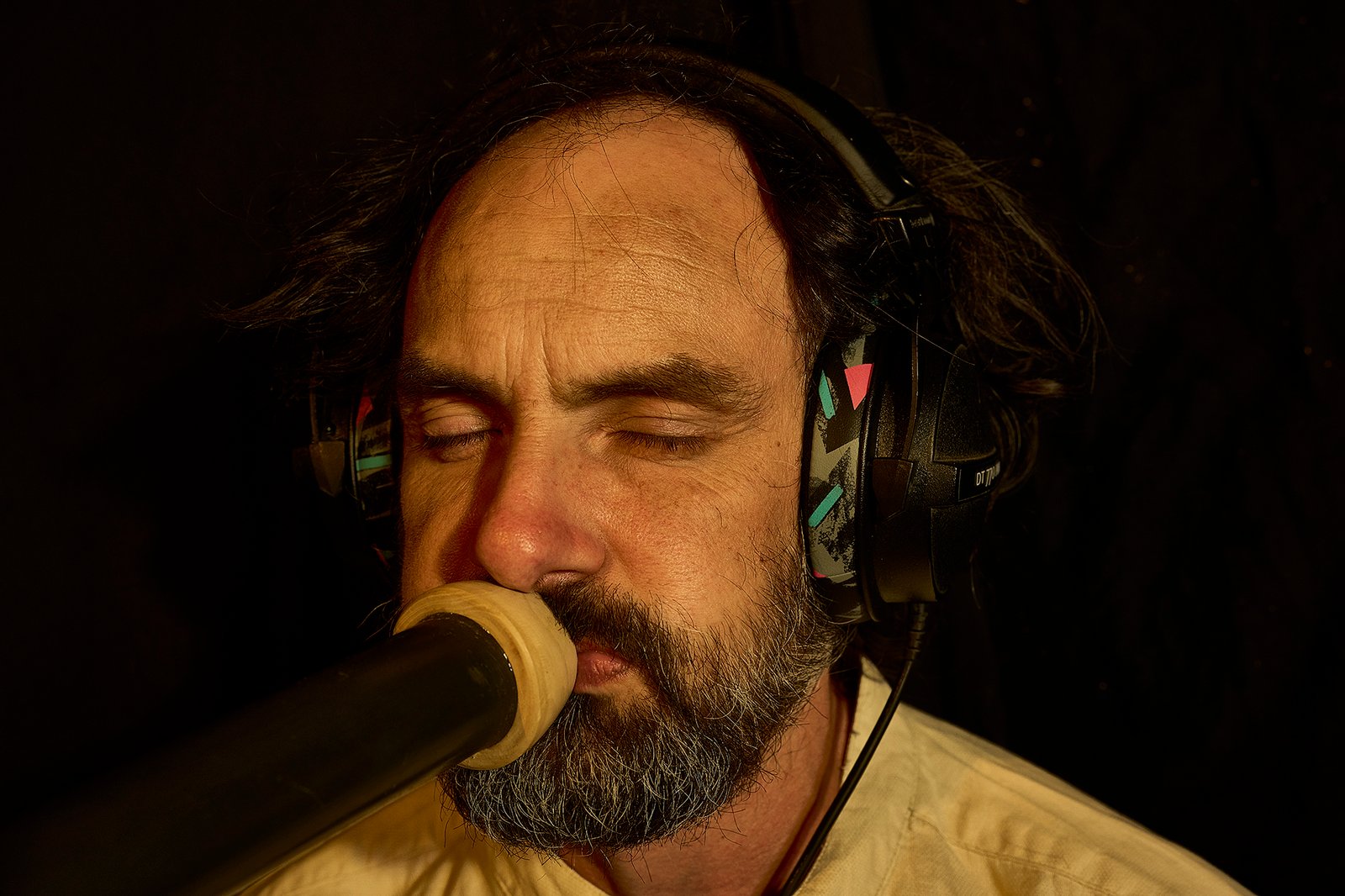
Acoustic research has shown how experienced didgeridoo players use the vocal tract, including changes in resonance around the mouth, throat and glottis, to transform the instrument’s spectral character.
This supports the description of the didgeridoo as a stable acoustic foundation whose harmonic field remains continuously variable.
A preliminary controlled study comparing live didgeridoo meditation with silent breath meditation reported greater self-reported relaxation and lower acute stress in the didgeridoo group.
The study supports further exploration of live didgeridoo listening. It does not establish treatment or universal benefit.
Why liveness matters
Research comparing live and recorded musical performance has reported differences in listener engagement and neural-acoustic phase-locking.
This supports an important SOS principle: live performance changes the relationship between sound, performer and listener. It does not mean every live performance creates the same neurological response.
Pulse, modulation and attention
The auditory nervous system responds to pitch, amplitude, temporal pattern, rhythm, spatial position and spectral change.
Periodic amplitude modulation can produce measurable auditory steady-state responses and phase-locking.
Rhythmic and binaural structures can influence attention and subjective state. SOS RPT uses these relationships as an evolving design space rather than a one-frequency–one-state formula.
Beyond hearing
Sound is both auditory information and a physical pressure wave.
Laboratory research has shown that cultured cells can respond to controlled acoustic stimulation through mechanosensory pathways, including changes in signalling and gene expression. This demonstrates that acoustic vibration can act as mechanical input to living systems.
It does not demonstrate that a particular frequency is inherently beneficial, and a cellular laboratory result does not establish a clinical effect in a person.
The participant’s own capacity
Sound, attention, environment, expectation, embodiment and individual physiology all influence how a participant experiences a session.
Sounds of Spirit creates conditions that support the listener’s own capacity for regulation, restoration and healing.
Some participants experience the sessions as calming, regulating, restorative or healing. Others experience changes in attention, embodiment, emotional state or perception.
SOS does not present those experiences as medical diagnosis or treatment and does not guarantee a specific physiological or neurological outcome.
Exploratory & spiritual foundations
Influences, not evidence
The frameworks in this section are presented as spiritual influences, conceptual models and research questions that have shaped the design and practice of Sounds of Spirit, not as established scientific mechanisms. They sit deliberately apart from the evidence-based material above.
Consciousness and intention
The deeper philosophy of Sounds of Spirit has been informed by energetic practice and by traditions or models exploring consciousness, intention, coherence, information and resonance.
These influences include Reiki practice, radionics, the SE-5 and Intrinsic Data Field (IDF) framework, Marcel Vogel’s work around quartz and intention, and exploratory water-intention research.
Within SOS, these remain spiritual influences, conceptual models and research questions, not settled scientific mechanisms.
Water and intention research
Masaru Emoto’s popular water-crystal demonstrations are culturally influential but are not strong enough to serve as a scientific foundation for Sounds of Spirit.
The later double-blind pilot by Dean Radin, Gail Hayssen, Masaru Emoto and Takashige Kizu is more relevant because it attempted to test distant intention under controlled conditions rather than presenting selected photographs.
It remains exploratory and does not establish a settled mechanism. Any future SOS work in this area would need a fully blinded, independently randomised design before any result could be reported publicly.
Questions worth testing carefully
Possible future work could examine:
- Participant experience during live and recorded sound
- SOS RPT on/off comparisons
- Different pulse and spatial configurations
- Attention, arousal and subjective brain states
- Acoustic and vibroacoustic reception
- Embodiment and perceived nervous-system regulation
- Carefully controlled intention-based experiments
Any formal study should use pre-defined outcomes, suitable controls, blinded procedures where possible and language proportionate to the evidence.